 Are you enjoying the bank holiday weekend? I know I am. A chance to spend some quality time with my other half and to catch up with my blog posts. Today I'm reflecting on the awesomeness that was the Blogging from A-Z Challenge 2013.

Showing posts with label A-Z Challenge 2013. Show all posts
Showing posts with label A-Z Challenge 2013. Show all posts
5 May 2013
Reflections on the A-Z Challenge
Are you enjoying the bank holiday weekend? I know I am. A chance to spend some quality time with my other half and to catch up with my blog posts. Today I'm reflecting on the awesomeness that was the Blogging from A-Z Challenge 2013.

1 May 2013
An A-Z of Fantasy and Sci-Fi

30 Apr 2013
Z is for Zombies #atozchallenge
 |
| [Image by Jeremy Keith, CC-BY-2.0] |
Zombies are undead beings, often portrayed as rotting corpses risen from the grave. In legend and folklore they are said to feed off the brains of the living. Lacking their own, they wander mindlessly and clumsily with vacant expressions on their faces, often making a groaning sound.
29 Apr 2013
Y is for Young Adult #atozchallenge
Today I'm continuing with the Blogging from A-Z Challenge hosted by Arlee Bird and his team of awesome bloggers. My theme is: Elements and features of speculative fiction and entertainment. So throughout April I will be blogging about characters, objects and themes that appear in sci-fi, fantasy and dystopian series. Today's post is all about the Young Adult genre and its relationship to speculative fiction.
The Young Adult genre (YA) is generally defined as being aimed at teens between 13 and 18 years old. But there's a lot of crossover, with mature 10-12 year olds and many adults also enjoying the genre. I'm nearly 24, and I still read widely within YA, primarily because a large percentage of fantasy, sci-fi, dystopian and paranormal fiction is aimed at young adults. This post from Karen McCoy, looks at data gathered from 35 librarians. When asked about which genres they were most likely to recommend to young adults, almost 50% said fantasy and about 15% said paranormal, compared to 25% for realistic fiction.
The Young Adult genre (YA) is generally defined as being aimed at teens between 13 and 18 years old. But there's a lot of crossover, with mature 10-12 year olds and many adults also enjoying the genre. I'm nearly 24, and I still read widely within YA, primarily because a large percentage of fantasy, sci-fi, dystopian and paranormal fiction is aimed at young adults. This post from Karen McCoy, looks at data gathered from 35 librarians. When asked about which genres they were most likely to recommend to young adults, almost 50% said fantasy and about 15% said paranormal, compared to 25% for realistic fiction.
27 Apr 2013
X is for Xenology #atozchallenge
 |
| [Image by Denis Bourez, CC 2.0. Source] |
Xenology is the scientific study of all aspects of extraterrestrial (alien) life, intelligence, and civilization.
26 Apr 2013
W is for Werewolves #atozchallenge
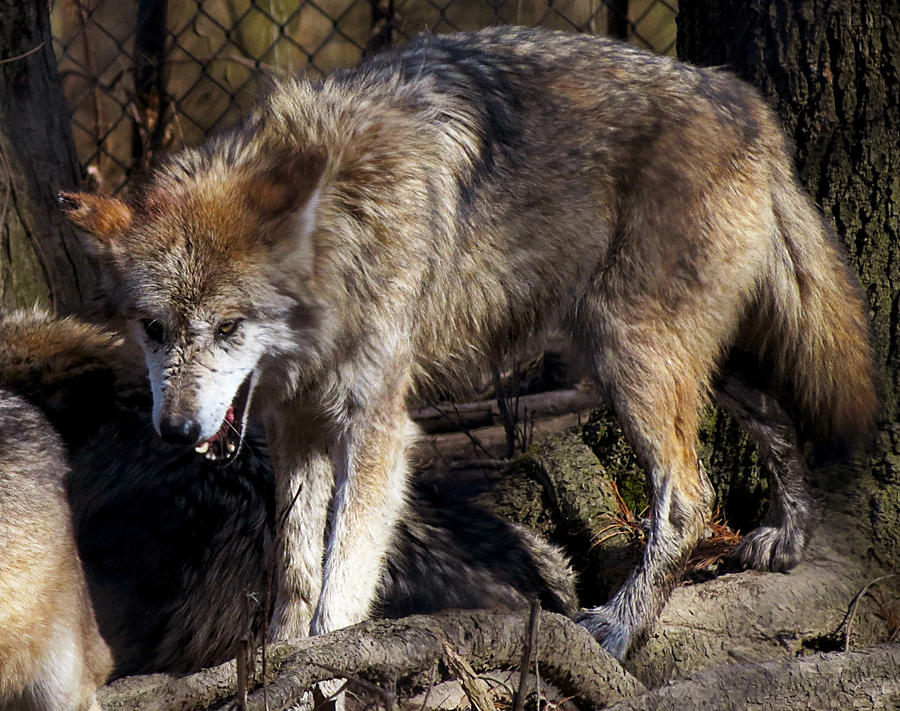 |
| [A Mexican grey wolf by HOTN Stock] |
Werewolves are legendary humans that are cursed to transform into wolf-like creatures, usually on the three nights of the full moon.
25 Apr 2013
V is for Vampires #atozchallenge
 |
| [Lady Vampire 8 by Marija-Buljeta] |
Vampires are legendary 'undead' creatures who drain the life or energy of humans, usually by drinking their blood. The term vampire was popularised in the early 18th century when Eastern Europeaners brought their superstition and folklore into Western Europe. John Polidori's 1891 novella The Vampyre, first depicted vampires as charismatic and sophisticated (rather than rotting corpses), and eventually inspired Bram Stoker's Dracula. The success of Dracula spawned a distinctive vampire genre, which is still popular today in literature and entertainment.
24 Apr 2013
U is for Unicorns #atozchallenge
 |
| [by A V Brown, using stock images. See here for full list of sources.] |
Unicorns are legendary animals from European folklore that resemble white horses with large spiral horns on their foreheads. They appeared first in ancient Greek natural history, rather than Greek mythology, as the Greeks were convinced that unicorns actually existed, believing that they came from India. Unicorns also appear in Chinese mythology and in The Bible.
23 Apr 2013
T is for Time travel #atozchallenge
 |
| ['Chaos Clock' by jayaprime on DA] |
Time travel is the concept of moving between different points in time-either back into the past or forward into the future. It has been a key feature of the sci-fi and fantasy genre since the 19th century, when H.G Well's novel The Time Machine popularised the idea.
22 Apr 2013
S is for Superpowers #atozchallenge
 |
| [modelled by sunshine114 on DA, photography by Mike Conner] |
Superpowers are abilities that go beyond normal human limits. Many originated from Marvel and DC comics before entering more mainstream sci-fi TV shows and films. Those who possess superpowers can be heroes or villains, using their powers for good or evil. They may be traditional 'superheroes' or paranormal creatures such as witches and wizards, vampires and werewolves.
20 Apr 2013
R is for Robots #atozchallenge
 |
| ['Asimo' by Honda. GNU FDL] |
Robots are mechanical or electrical inventions (usually controlled by computer programs) and designed to mimic human form or behaviour in order to help with certain tasks. There are several different types of robot, including androids (robots designed to look like humans), cyborgs (humans with significant mechanical enhancements) and replicants (genetically engineered or artificial beings designed to be an exact replicas of a particular human being ).
19 Apr 2013
Q is for Quests #atozchallenge
 |
| [Image by Vassil, Public Domain] |
Quests have featured in the mythology and legend of many cultures for centuries and are used frequently as a plot device in fantasy literature. The hero must embark upon a difficult journey (whether literal or metaphorical) to reach a goal or claim a prize of some kind. Usually they must travel a great distance in order to do so, with some allies accompanying them. This allows the author to describe interesting and exotic scenery (mountain rages, caves, turbulent oceans etc.) and showcase different cultures and perhaps fantasy creatures that inhabit these places.
18 Apr 2013
P is for Possession #atozchallenge
 |
| [Stock image by soraneko, CC Licence. Edited by Anstice Potts] |
Possession is a supernatural happening whereby a person's body is taken over by the soul or spirit of someone else, or by a demon. This renders the person incapable of acting on their own free-will, though they may appear unchanged and the possession may go unnoticed. Many cultures and religions around the world have some sort of concept of demonic possession, but the details vary. Sometimes an exorcism or cleansing ritual is deemed necessary to banish the malevolent demon. However, some forms of spirit possession by humans, animals or gods (particularly in tribal cultures) are seen as beneficial and undertaken voluntarily.
17 Apr 2013
O is for Ogres and Giants #atozchallenge
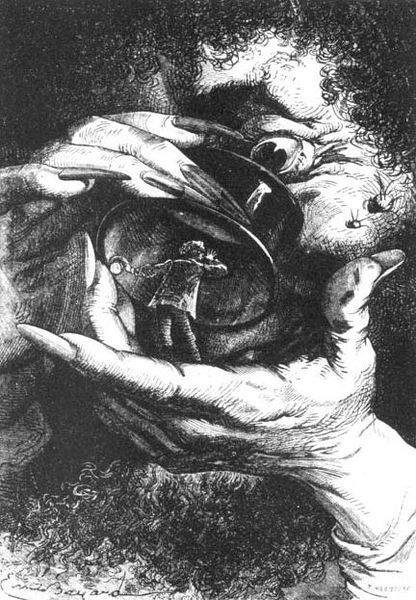 |
| [By Émile Bayard, Public Domain] |
Ogres are large, hideous monsters from mythology and folklore with a penchant for devouring humans (particularly children). They were often described in fairy tales to scare children into obedience. The word ogre is French, but there are a lot of different possibilities as to where the myth comes from. Some say it is based on early descriptions of Neanderthals, or possibly on the real-life crimes of Gilles de Rais (a prolific child serial killer also thought to have inspired the Bluebeard fairytale).
16 Apr 2013
N is for Nanotechnology #atozchallenge
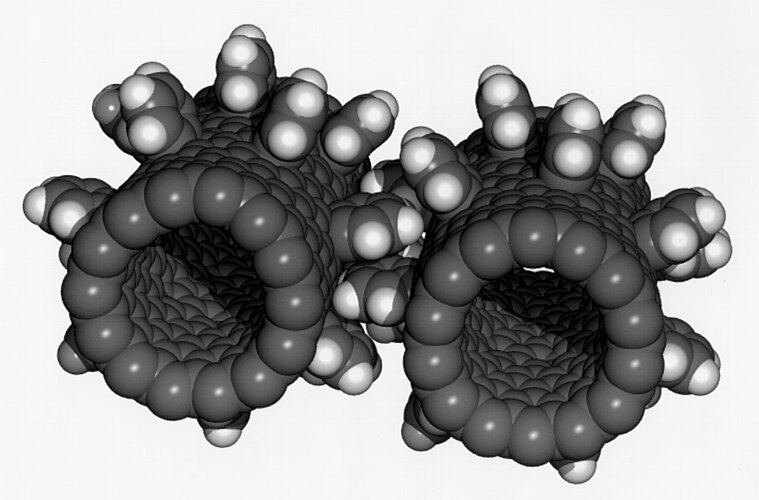 |
| ['Fullerene Nanogears' by NASA, public domain image] |
Nanotechnology or 'nanotech' is the manipulation of matter on an atomic and molecular scale. It has a variety of potential applications, including industrial, medical and military and governments have invested billions of dollars in its research. It may be used to create many new materials and devices. However, it raises concerns about the toxicity and the environmental impact of nanomaterials and speculation about various doomsday scenarios. Nanotechnology frequently appears in modern science fiction as a plausible explanation for things like robots and the regeneration of objects and organisms.
15 Apr 2013
M is for Mermaids and Mermen #atozchallenge
 |
| [Painting by John William Waterhouse, public domain image] |
Today I'm continuing with the Blogging from A-Z Challenge hosted by Arlee Bird and his team of awesome bloggers. My theme is: Elements and features of speculative fiction and entertainment. So throughout April I will be blogging about characters, objects and themes that appear in sci-fi, fantasy and dystopian series. Today's post is all about Mermaids and Mermen.
Mermaids are legendary creatures with the torso of a human and the tail of a fish. They appear in the folklore of many cultures worldwide. They are sometimes depicted as perilous creatures associated with floods, storms, shipwrecks and drownings. However, they can also be benevolent creatures in some tales. They are associated with the Sirens from Greek mythology and have been a popular subject of art and literature in recent centuries, since Hans Christian Anderson wrote the fairy tale 'The Little Mermaid' in 1836.
13 Apr 2013
L is for Lost in space #atozchallenge
 |
| [Image by S.Ivanov, Creative Commons 3.0] |
Being lost in space is a common trope in science fiction. A catastrophe destroys planet Earth or makes it uninhabitable, leaving a few survivors travelling the universe with no particular home. Or sometimes Earth still exists but the protagonists have been separated from it by a huge spacial and temporal distance and are desperately trying to find their way home.
12 Apr 2013
K is for Kraken #atozchallenge
 |
| [An illustration from the original 1870 edition of Twenty Thousand Leagues Under the Sea, by Jules Verne. Public domain image] |
Today I'm continuing with the Blogging from A-Z Challenge hosted by Arlee Bird and his team of awesome bloggers. My theme is: Elements and features of speculative fiction and entertainment. So throughout April I will be blogging about characters, objects and themes that appear in sci-fi, fantasy and dystopian series. Today's post is all about Krakens.
Krakens are gigantic legendary sea monsters said to dwell off the coasts of Norway and Greenland. The word kraken comes from the Norwegian 'krake', which means an unhealthy animal or something twisted. The early descriptions of krakens were of crab-like creatures, but more recently they are usually portrayed as octopus or squid-like creatures with huge tentacles and a beak-like mouth.
11 Apr 2013
J is for Jinn #atozchallenge
 |
| Aladdin and the Wonderful Lamp |
Stories of jinn or djinn can be found in various Muslim cultures around the world. They are spirits mentioned in the Qurʾān who inhabit an unseen world in dimensions that are not visible to humans. Jinn, humans and angels are believed to be the three sentient creations of God. They are made of smokeless and 'scorching fire'. Unlike angels, they have freewill and can be good, evil or neutral. Jinn means 'hidden from sight' in Arabic, as they are not normally visible to humans. However, they can take on the form of nearly any creature to allow humans to see them.
10 Apr 2013
I is for Immortality #atozchallenge
 |
| ['Stock-Immortal', modelled by Mahafsoun, photographed by Mirza Fatick] |
Immortality means endless life or endurance. It has always been a common theme in literature as it explores humanity's deep-seated fears and comprehension of its own mortality. It frequently occurs in fantasy and sci-fi fiction, as it is often the aim of the villain or dark forces to gain eternal life, and the role of the protagonist to stop them from achieving it.
Subscribe to:
Posts
(
Atom
)